


Markets have a way of making fools of consensus. Six months ago, investors expected the Federal Reserve to cut interest rates several times this year. Now, markets have priced in the possibility of perhaps one rate hike over the next several months. Investors increasingly believe the economy may be entering a period of sustainably higher interest rates. That view reflects several forces coming together: an economy that continues to show resilience, a massive AI-driven capital spending cycle, and persistent supply constraints, particularly around energy and critical components needed for data centers.
Taking a step back, from the Global Financial Crisis through the Covid era, investors operated under a familiar assumption. Interest rates would remain low, central banks would provide a reliable backstop, and any meaningful market weakness would eventually be met with easier monetary policy. That era appears to be changing.
Take a look at the 30-year Treasury yield, which recently climbed to its highest level since the mid-2000s.
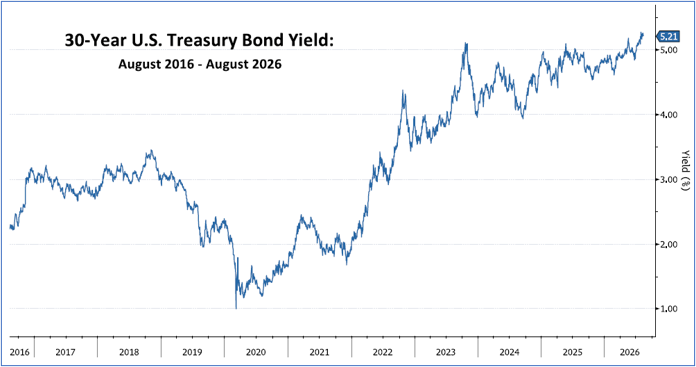
One thing that stands out from this chart is that we must go back to 2024 to find the most recent significant low in long-term yields, and even then, the drop was modest in the context of an upward climbing trend that began in 2020. In some ways, the bond market appears to have moved ahead of the inflation and capital spending narrative.
While we hear a lot about the influences of inflation and employment data on Fed decisions, there is a longstanding Wall Street notion that it is the bond market that tells the Federal Reserve what to do. The reason is simple: bond yields influence the cost of capital throughout the economy. When investors demand greater compensation to own long-term debt, policymakers eventually have to acknowledge that reality. It is not a hierarchy as much as it is a dance, with each side responding to the other. Based on recent comments, Fed Chair Warsh appears comfortable with that relationship, at least for now. For equity investors, this raises an important question: Falling interest rates have provided tailwinds to rising stocks, but what happens when that is no longer the case? The traditional argument is straightforward. Higher real yields, or yields adjusted for expected inflation, increase the discount rate investors apply to future earnings. A higher discount rate means a lower valuation which may lead to depressed stock prices.
Every investor faces a basic choice: earn a relatively risk-free return from bonds or accept the risks associated with owning publicly traded companies. That decision becomes especially important today because the AI buildout represents one of the most capital-intensive investment cycles in decades. Companies are spending enormous amounts on data centers, semiconductor capacity, networking equipment, and electric infrastructure. Much of this spending is financed with debt. However, higher interest rates introduce another consideration for corporate executives: if additional capital is needed, issuing equity may become more attractive relative to taking on additional long-term debt. More equity issuance is not always good for specific share prices.
The good news is that history suggests higher bond yields are not automatically bad for stocks. During the late 1990s and much of the period leading up to the Global Financial Crisis, Treasury yields moved higher alongside a rapidly expanding economy. Investors accepted higher interest rates because nominal GDP growth and corporate earnings were strong. Even during the dot-com crash of 2000, the 10-year Treasury yield declined from roughly 6% to 4% as economic growth slowed.
If yields rise because the economy is strong, stocks can continue to perform well. The specific industries and names that outperform may change, but a healthy economy can support higher rates. However, if yields rise because of the bad things: too much inflation, excessive leverage, financial stress, or questions surrounding the government’s ability to manage its debt burden, the outlook becomes challenging, to put it bluntly.
For now, corporate earnings expectations remain strong, albeit much of that optimism is concentrated among companies directly tied to artificial intelligence. And all is not rosy. Higher borrowing costs continue to weigh on housing affordability, making it more difficult for younger people to buy homes. Inflation remains a challenge for household budgets. More broadly, if interest rates remain elevated, wage growth will need to keep pace to support consumer spending and preserve purchasing power. Over time, those pressures could weigh on corporate profit margins.
A higher-rate environment may also change market leadership. The past decade rewarded companies with long-dated growth potential because investors were willing to pay higher valuations for future earnings. A world of higher interest rates could be less forgiving toward companies dependent on distant cash flows and more supportive of businesses generating strong free cash flow today. That does not mean that well-run AI-related growth companies will not thrive in this environment, but it is also no coincidence that many regional banks and other value-oriented sectors have quietly traded near multi-year highs this summer. Traditional measures such as dividend yields, earnings quality, and free cash flow may once again become central to investment discussions.
Forecasts are rarely perfect, and the future has a way of humbling even the strongest convictions. Few investors confidently predicted this year’s energy challenges or the scale of the AI investment boom that emerged after concerns about a global slowdown. But uncertainty does not mean investors should ignore the signals markets are sending. The investment landscape appears to be changing. Bonds could begin competing for investor capital, and companies will need to continually prove that large investments can translate into durable earnings and attractive returns.
In our April piece on the coming Warsh regime at the Fed, we compared the shift to changing the referee in a soccer game. The game itself remains the same, but the nuanced judgments can change. We believe that analogy still applies in a higher-rate environment. The rules of investing have not been rewritten, but the subtleties have changed. Importantly, that does not mean the end of this bull market.
Nick Bundy